



Young Adults and the Softening U.S. Labor Market: A Warning Sign?
Since the labor market peaked in April 2023, signs of softening have become increasingly evident. Nationally, the unemployment rate has risen from 3.4% to 4.4%. Job openings have dropped by 23.2% (2.3 million), quits are down 18.7%, and layoffs are up 10%—all suggesting growing worker and employer uncertainty.
Similar trends are evident in the Eighth Federal Reserve District.The Eighth District covers all of Arkansas, most of Missouri, and parts of Illinois, Indiana, Kentucky, Mississippi and Tennessee. The collective unemployment rate for Eighth District states increased from 3.7% to 4.3%, job openings fell by 39.0% (359,000), and layoffs were up 3.3%. Hires and quits declined by 13.0% and 22.1%, respectively. These shifts suggest the Eighth District labor market may be weakening more than the national average.
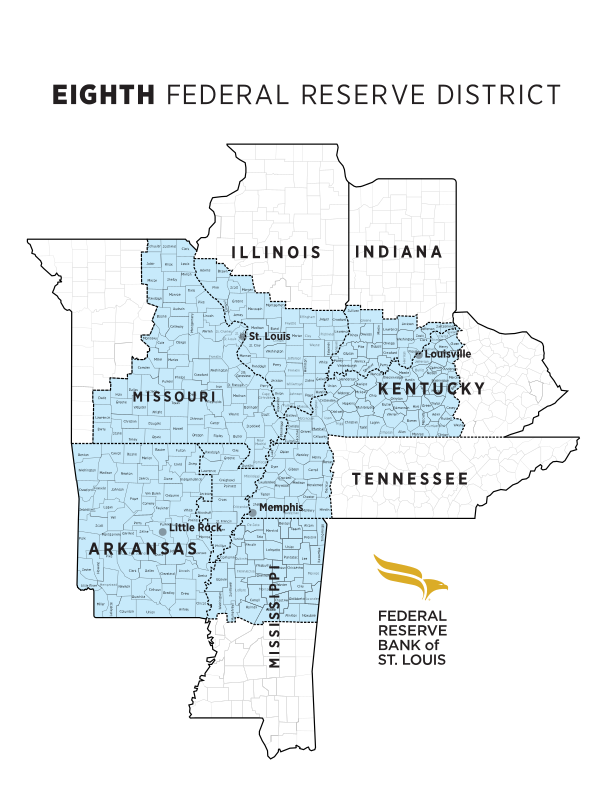
Young Adults Are Feeling the Strain
Beneath these headline numbers lies a more troubling trend: Young adults, especially those not in school and without a college degree, are being hit hardest.
In earlier work, we defined economically vulnerable groups as those with lower-than-average employment-to-population ratios and greater sensitivity to changes in labor demand. Among these, out-of-school young adults—nonenrolled 18- to 24-year-olds with no more than a high school diploma—stand out. Even at the labor market’s peak of tightness in April 2023, their unemployment rates were more than double the national average. For example, in that month, 8.3% of urban out-of-school young adults in the U.S. were unemployed, compared with the rate of 3.4% for all adults. In the Eighth District, the unemployment rate for this group exceeded 10.0%.Because of small sample sizes for this group, the estimates are quite noisy. Thus, we present only a broad estimate.
Why Are Young Adults So Exposed?
Our analysis of monthly Current Population Survey microdata from January 2017 to July 2025, plus month and state data from the Bureau of Labor Statistics’ Job Openings and Labor Turnover Survey (JOLTS) for the same period, shows that across the U.S. and Eighth District states, young adults’ unemployment rates are highly sensitive to changes in job openings.To estimate these relationships, we use January 2017 to July 2025 microdata from the monthly Current Population Survey, sponsored jointly by the U.S. Census Bureau and the U.S. Bureau of Labor Statistics. We regress a dummy variable that equals 1 if an individual is unemployed and 0 if an individual is employed on the logarithm of the Bureau of Labor Statistics’ state-level job openings, plus a detailed list of predictor variables: educational attainment, potential experience (age minus years of schooling minus 6), race and ethnicity, gender, marital status, household income, state, month and year. As of this writing, July 2025 was the latest date for which all data were available.
The figure below shows that at the national level, a 1 percentage point increase in the job openings rate is associated with a 0.67 percentage point to 1.61 percentage point decrease in the jobless rate of out-of-school young adults. The impact of an increase in job openings on out-of-school young adults is more than double that estimated for the general population.
Change in Out-of-School Young Adult Unemployment from a 1 Percentage Point Increase in Job Openings

SOURCES: Current Population Survey microdata (January 2017-July 2025), JOLTS (January 2017-July 2025) and authors’ calculations.
Estimates for the Eighth District show similar patterns. Notably, out-of-school young Black adults in Eighth District states are among the most sensitive to changes in job openings. While we calculated positive estimates of 0.49 percentage points for out-of-school young Latino adults and 3.81 percentage points for out-of-school young adults in an “other races” category, the standard error is high, indicating little precision.
This heightened sensitivity reflects the precarious position of young adults in the labor market. Many lack the credentials or experience to compete for higher-skilled roles. Also, they are often concentrated in lower-paying sectors like retail, transportation and leisure—industries that have seen weak employment growth in recent months.
A Persistent and Historical Challenge
Higher unemployment rates among out-of-school young adults are not new. Since 1986, every recession has been followed by sharp declines in employment-to-population ratios for this group, especially young Black adults and young Latino adults. In contrast, new entrants—those with no more than 10 years of experience—who have college degrees generally have fared better.
Since the labor market’s April 2023 peak, employment-to-population ratios among out-of-school young adults have trended downward, in some months nearing historical lows. Many are not just unemployed but leaving the labor force altogether, perhaps returning to school, facing health challenges or disengaging entirely.
Recently, a new pattern has emerged: rising unemployment among young, new-entrant college graduates. At the labor market’s peak, their unemployment rates were 4.2% nationally and 1.8% in the Eighth District. As of August 2025, both rates exceeded 8.0%, with the national estimate being slightly higher.
What’s Driving the Decline?
The drop in job openings since the labor market peak explains a significant portion of each group’s rising unemployment. Labor market forces currently at play include:
- Weaker consumer spending: Personal consumption remains below early 2023 levels.
- Federal spending cuts: Nondefense expenditures fell 13% (annualized quarter over quarter) in the second quarter of 2025.
- Manufacturing contraction: The sector has shed 38,000 jobs since January 2025.
- AI investment: New college graduates may struggle to compete in increasingly tech-driven workplaces.
- Immigration decline: The U.S. foreign-born population has dropped by over 1 million since January 2025.
Young Adults: A Canary in the Coal Mine?
Young adults are often the first to feel the effects of a weakening labor market. Their rising unemployment and labor force exits may be early warning signs of broader trouble ahead. If history is any guide, we might expect further increases in unemployment, especially among workers with limited education and experience.
To explore this issue, we estimate the relationship between the job openings rate and the unemployment rate—that is, when plotted, the Beveridge curve—for out-of-school young adults over two periods: the tight labor market (March 2022 to April 2023) and its potential slowdown (May 2023 to July 2025). The first table below shows little difference between predicted Beveridge curves for these periods, even for the group most sensitive to changes in the labor market: out-of-school young Black adults. Pointing out which demographic group of those in our analysis is the most sensitive to labor market changes illustrates how employment experiences can vary even among out-of-school young adults.
| Job Openings Rate | Unemployment Rate | |||||
|---|---|---|---|---|---|---|
| All Adults | Out-of-School Young Adults | Out-of-School Young Black Adults | ||||
| Tight | Slowdown | Tight | Slowdown | Tight | Slowdown | |
| U.S. | ||||||
| 4.1% | 4.0% | 4.0% | 12.9% | 11.9% | 24.9% | 22.7% |
| 4.5% | 3.9% | 3.8% | 12.3% | 11.3% | 23.1% | 20.8% |
| 5.0% | 3.7% | 3.7% | 11.7% | 10.7% | 21.2% | 18.9% |
| 5.5% | 3.6% | 3.5% | 11.1% | 10.1% | 19.3% | 17.0% |
| 6.0% | 3.4% | 3.4% | 10.5% | 9.5% | 17.4% | 15.1% |
| 6.7% | 3.3% | 3.3% | 9.9% | 8.9% | 15.5% | 13.2% |
| 7.4% | 3.1% | 3.1% | 9.3% | 8.3% | 13.6% | 11.3% |
| Eighth District | ||||||
| 4.1% | 4.5% | 4.3% | 10.9% | 12.0% | 14.2% | 18.7% |
| 4.5% | 4.3% | 4.1% | 10.5% | 11.6% | 14.2% | 18.6% |
| 5.0% | 4.0% | 3.9% | 10.1% | 11.2% | 14.1% | 18.5% |
| 5.5% | 3.8% | 3.7% | 9.7% | 10.8% | 14.0% | 18.4% |
| 6.0% | 3.6% | 3.5% | 9.3% | 10.4% | 13.9% | 18.3% |
| 6.7% | 3.4% | 3.3% | 8.9% | 10.0% | 13.8% | 18.3% |
| 7.4% | 3.2% | 3.0% | 8.5% | 9.6% | 13.8% | 18.2% |
| SOURCES: Current Population Survey microdata (January 2017-July 2025), JOLTS (January 2017-July 2025) and authors’ calculations. | ||||||
| NOTES: The tight labor market period corresponds to March 2022 to April 2023. The period of the potential labor market slowdown corresponds to May 2023 to July 2025. Beveridge curve data are from a regression of whether an individual is unemployed on a series of dummy variables. The log of state-level job openings is added and interactions between the dummy variables and job openings are included. The coefficients from these models are used to generate predicted unemployment rates for a given job openings rate. | ||||||
Trends in Predicted Monthly Beveridge Curves
As a final check, we estimate monthly young-adult Beveridge curve data from January 2025 to July 2025 for the U.S. (first table below) and Eighth District (second table below). These month-to-month curves tell a different story from the previous, pooled estimates. Earlier in the year, the curves shifted inward, signaling improved job matching and fewer search inefficiencies. The number and size of barriers to obtaining a job continued to ease.
However, starting in April, the curves for the Eighth District began to shift outward. By May, the Beveridge curve for young adults also shifted, with unemployment rates often exceeding 10% by June.
| Job Openings Rate | Unemployment Rate | ||||||
|---|---|---|---|---|---|---|---|
| January | February | March | April | May | June | July | |
| All Adults | |||||||
| 4.1% | 4.1% | 4.1% | 3.9% | 3.6% | 3.7% | 4.1% | 4.3% |
| 4.5% | 4.0% | 4.1% | 3.9% | 3.6% | 3.7% | 4.1% | 4.2% |
| 5.0% | 4.0% | 4.0% | 3.8% | 3.5% | 3.7% | 4.0% | 4.2% |
| 5.5% | 4.0% | 4.0% | 3.8% | 3.5% | 3.7% | 4.0% | 4.2% |
| 6.0% | 3.9% | 4.0% | 3.8% | 3.5% | 3.6% | 4.0% | 4.1% |
| 6.7% | 3.9% | 3.9% | 3.7% | 3.4% | 3.6% | 3.9% | 4.1% |
| 7.4% | 3.9% | 3.9% | 3.7% | 3.4% | 3.6% | 3.9% | 4.1% |
| Out-of-School Young Adults | |||||||
| 4.1% | 12.3% | 11.5% | 11.6% | 11.0% | 9.6% | 13.0% | 12.0% |
| 4.5% | 12.0% | 11.3% | 11.3% | 10.8% | 9.4% | 12.8% | 11.8% |
| 5.0% | 11.8% | 11.1% | 11.1% | 10.5% | 9.2% | 12.6% | 11.5% |
| 5.5% | 11.6% | 10.8% | 10.9% | 10.3% | 9.0% | 12.3% | 11.3% |
| 6.0% | 11.3% | 10.6% | 10.6% | 10.1% | 8.7% | 12.1% | 11.1% |
| 6.7% | 11.1% | 10.4% | 10.4% | 9.8% | 8.5% | 11.9% | 10.8% |
| 7.4% | 10.9% | 10.1% | 10.2% | 9.6% | 8.3% | 11.6% | 10.6% |
| SOURCES: Current Population Survey microdata (January 2025-July 2025), JOLTS (January 2025-July 2025) and authors’ calculations. | |||||||
| NOTES: Monthly predicted Beveridge curve data are from a regression of whether an individual is unemployed on the logarithm of state-level job openings rate and a series of month and year dummy variables. The job openings rate is interacted with the month and year dummy variables. Interactions of month and year are also included. The coefficients from these models are used to generate predicted unemployment rates for a given job openings rate. | |||||||
| Job Openings Rate | Unemployment Rate | ||||||
|---|---|---|---|---|---|---|---|
| January | February | March | April | May | June | July | |
| All Adults | |||||||
| 4.1% | 4.4% | 4.6% | 4.3% | 3.7% | 4.0% | 4.8% | 4.9% |
| 4.5% | 4.1% | 4.4% | 4.0% | 3.4% | 3.8% | 4.5% | 4.6% |
| 5.0% | 3.9% | 4.1% | 3.7% | 3.2% | 3.5% | 4.2% | 4.4% |
| 5.5% | 3.6% | 3.8% | 3.5% | 2.9% | 3.2% | 3.9% | 4.1% |
| 6.0% | 3.3% | 3.5% | 3.2% | 2.6% | 2.9% | 3.7% | 3.8% |
| 6.7% | 3.0% | 3.2% | 2.9% | 2.3% | 2.7% | 3.4% | 3.5% |
| 7.4% | 2.7% | 3.0% | 2.6% | 2.1% | 2.4% | 3.1% | 3.2% |
| Out-of-School Young Adults | |||||||
| 4.1% | 16.5% | 15.1% | 13.0% | 10.8% | 9.9% | 17.2% | 16.8% |
| 4.5% | 14.7% | 13.4% | 11.2% | 9.0% | 8.1% | 15.4% | 15.0% |
| 5.0% | 12.9% | 11.6% | 9.5% | 7.2% | 6.3% | 13.7% | 13.2% |
| 5.5% | 11.2% | 9.8% | 7.7% | 5.4% | 4.5% | 11.9% | 11.5% |
| 6.0% | 9.4% | 8.0% | 5.9% | 3.7% | 2.8% | 10.1% | 9.7% |
| 6.7% | 7.6% | 6.2% | 4.1% | 1.9% | 1.0% | 8.3% | 7.9% |
| 7.4% | 5.8% | 4.5% | 2.4% | 0.1% | N/A | 6.5% | 6.1% |
| SOURCES: Current Population Survey microdata (January 2025-July 2025), JOLTS (January 2025-July 2025) and authors’ calculations. | |||||||
| NOTES: Monthly predicted Beveridge curve data are limited to the sample of individuals that reside in one of the seven Eighth District states. Data are from a regression of whether an individual is unemployed on the logarithm of state-level job openings rate and a series of month and year dummy variables. The job openings rate is interacted with the month and year dummy variables. Interactions of month and year are also included. The coefficients from these models are used to generate predicted unemployment rates for a given job openings rate. | |||||||
Looking Ahead
Despite challenges, the overall labor market remains strong. Still, the employment experiences of young adults warrant close monitoring. Their struggles may foreshadow broader economic shifts.
Notes
- The Eighth District covers all of Arkansas, most of Missouri, and parts of Illinois, Indiana, Kentucky, Mississippi and Tennessee.
- Because of small sample sizes for this group, the estimates are quite noisy. Thus, we present only a broad estimate.
- To estimate these relationships, we use January 2017 to July 2025 microdata from the monthly Current Population Survey, sponsored jointly by the U.S. Census Bureau and the U.S. Bureau of Labor Statistics. We regress a dummy variable that equals 1 if an individual is unemployed and 0 if an individual is employed on the logarithm of the Bureau of Labor Statistics’ state-level job openings, plus a detailed list of predictor variables: educational attainment, potential experience (age minus years of schooling minus 6), race and ethnicity, gender, marital status, household income, state, month and year. As of this writing, July 2025 was the latest date for which all data were available.


Citation
William M. Rodgers III and Alice L. Kassens, ldquoYoung Adults and the Softening U.S. Labor Market: A Warning Sign?,rdquo St. Louis Fed On the Economy, Dec. 15, 2025.
This blog offers commentary, analysis and data from our economists and experts. Views expressed are not necessarily those of the St. Louis Fed or Federal Reserve System.
Email Us
All other blog-related questions