


President Musalem Answers Four Questions about the Fed
St. Louis Fed President Alberto Musalem covers a wide range of important topics in this Q&A. He touches on the benefits of the Fed’s decentralized structure, how he prepares for Federal Open Market Committee (FOMC) meetings, and the importance of monetary policy independence. He also shares one thing he wishes more people knew about the Fed: all the ways we serve the American people, in addition to conducting monetary policy.
Q: What are the benefits of the Fed’s decentralized structure?
A: When Congress established the Fed more than 100 years ago — with the Board of Governors in Washington, D.C., and 12 Federal Reserve banks spread throughout the country — it recognized that economic conditions vary widely across the United States. Congress gave the Fed its decentralized structure to ensure voices from all over the country, beyond just Washington, D.C., and New York, would be represented in monetary policy discussions.
And today, for a country as large and complex as ours — with a $32 trillion economy, 343 million people, and a wide set of communities and industries — the Fed’s decentralized structure works well. It allows for balanced policymaking because all the views are brought to the table at the same time. It also helps avoid groupthink and foster independent decisions on behalf of the American people.
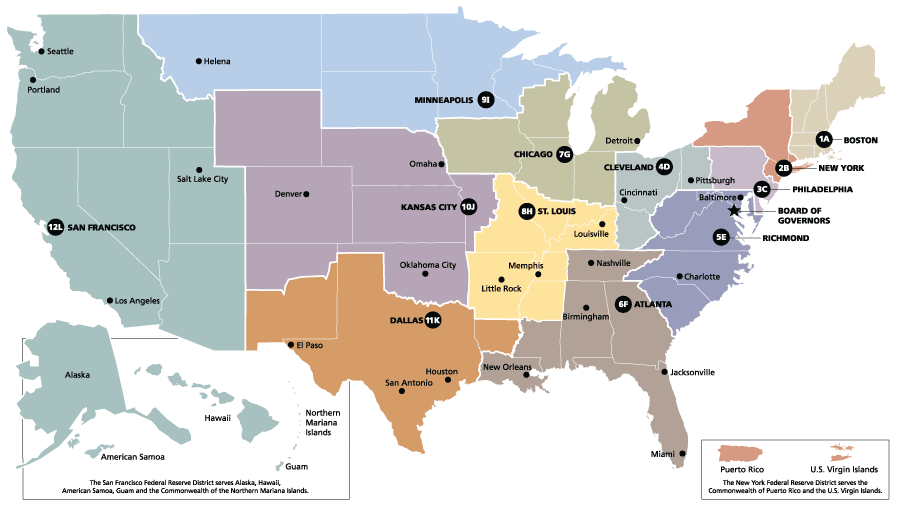
How does this happen? The presidents of the 12 Reserve banks bring their perspectives on economic conditions in their districts to the FOMC table. For example, as president of the St. Louis Fed, I regularly visit communities across the Eighth Federal Reserve District, which serves 15 million people and spans all or parts of seven states. In those visits, I hear directly from the people we serve to fully understand how they are experiencing the economy. Directly connecting with the people we serve allows me to bring their perspectives to the monetary policy table.
Q: How do you prepare for FOMC meetings? How does your community engagement factor in?
A: Preparing for FOMC meetings involves taking a broad set of inputs over a period of weeks leading up to the meeting. I use all available information to continuously update my outlook on the economy, the balance of risks around that outlook, and my view on the appropriate path of interest rates. We have an incredible team of economic researchers at the St. Louis Fed, and they provide me with outstanding insights and data on a daily basis. My team and I look at official government statistics, international data and privately produced data to understand the current state of the economy. Those data also serve as inputs to econometric models that produce forward-looking “what if” policy exercises — that is, what might happen to the economy if we set monetary policy a certain way?

President Musalem (center) participates in a roundtable discussion with business leaders from across Kentucky and Southern Indiana in June 2026.
Community engagement is another critical input, as I mentioned earlier. When I interact with people and businesses of the Eighth District, I gain local, regional, national and global insights about the economy, the labor market and inflation. In addition, I learn how financial conditions are impacting people in the district. That is important because financial conditions are the way monetary policy is transmitted through the economy. Of course, my outreach efforts aren’t limited to the Eighth District. I also engage with contacts from around the country and globally to help inform my views.
At the St. Louis Fed, we have a saying: “Anecdotes become data.” What we hear when we interact with people often shows up in official data three to six months later. So, having those conversations is really important.
I am sometimes asked if I prepare for FOMC meetings differently when I’m a voting member. I feel the same sense of responsibility to the American people and have the same engagement with my FOMC colleagues whether I’m a voting member or not. We have a rich discussion at each meeting, and I learn a tremendous amount from all of my colleagues. The debate is always objective, fact-based and rigorous, with everyone committed to delivering maximum employment and stable prices on behalf of the American people.
Q: Why is central bank independence important?
A: Central bank independence is really about monetary policy independence, which refers to the ability to conduct monetary policy free of any short-term political influence.

President Musalem discusses the U.S. economy and monetary policy at a January 2026 event in Rogers, Ark. Also shown is Matuschka Lindo Briggs, regional executive of our Little Rock Branch.
In the U.S., Congress by law gave the Fed a mandate to deliver maximum employment and price stability. So, we’re not independent in choosing what we have to do. But we are independent in deciding how to use our tools to achieve our mandate, based on facts, rigor and analysis.
Why does this matter? History has shown that countries with more independent monetary policy tend to have better economic outcomes for their populations. For instance, they tend to have lower and more stable inflation, and higher and more stable employment.
With monetary policy independence comes an obligation for accountability and transparency to Congress and to the public. We have to explain why we’re doing what we’re doing in terms of policy, and how everything we do is intended to achieve the mandate Congress gave us.
Tying back to an earlier question, the 12 Federal Reserve banks are a cornerstone of monetary policy independence because they bring independent views from all over the country to the monetary policy table.
Q: What is one misconception about the Fed or something you wish more people knew?
A: People often know the Fed sets monetary policy. But they may not know all the other ways the Fed affects the lives of the people we serve. This is an area deserving more awareness.
In addition to their role in formulating monetary policy as discussed above, the 12 Reserve banks provide critical services to the economy. For example:
- They help keep your money safe. Our supervisory staff examine banks to help make sure the financial system remains safe, stable and sound.
- They help keep your money moving. Every time you send a wire, write a check or take money out of an ATM, the Reserve banks are in the background helping ensure those transactions happen. In fact, the Fed facilitates more than $5 trillion in payments per day.
- They promote consumer protection and community development. Reserve banks help make sure everyone has fair access to financial products and services. They also help support economic growth and financial stability in communities, particularly low- and moderate-income ones.
- They are the government’s banker. Some Reserve banks, including the St. Louis Fed, provide fiscal agent services to the U.S. Treasury. This is a fancy way to say we serve as the banker to the U.S. Treasury.
In my experience, when people understand the work we do and how we do it, they are incredibly supportive of the Fed. I encourage anyone interested in learning more about how we serve the American people to explore the St. Louis Fed’s annual impact report.
This blog explains everyday economics and the Fed, while also spotlighting St. Louis Fed people and programs. Views expressed are not necessarily those of the St. Louis Fed or Federal Reserve System.
Email Us